ChatGPT GEO
What ChatGPT reads before it answers, what the citation studies show, and which GEO tactics have evidence behind them.
Most of what gets sold as GEO is SEO with a new invoice attached. The things that get a page cited in ChatGPT are, with a handful of exceptions, the things that got it ranking in Google in the first place.
The exceptions are real and worth knowing. This page separates them from the sales pitch using published data, and it names the studies so you can check them yourself.
Money is arriving regardless of what the mechanics turn out to be. Profound, one of the tools built to measure AI visibility, raised a $96 million Series C at a $1 billion valuation in February 2026. Gartner’s 2026 CMO Spend Survey puts 15.3% of marketing budgets against AI. Budgets are moving, so the category is becoming real whether or not the tactics are.
How ChatGPT reads the web
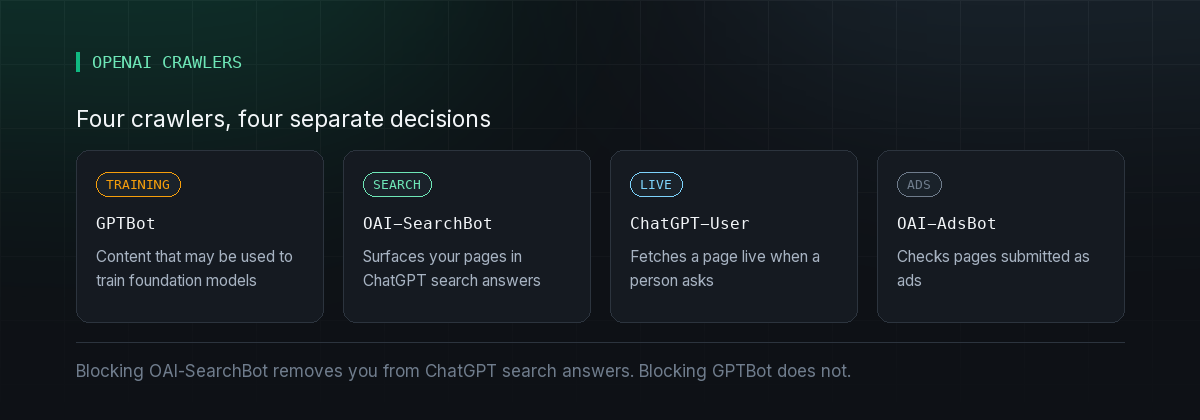
OpenAI runs four crawlers, and they do different jobs. Confusing them is the most expensive mistake on this page, because two of the four decide whether you can be cited at all.
| Agent | What it does |
|---|---|
GPTBot | Collects content that may be used to train foundation models |
OAI-SearchBot | Surfaces websites in ChatGPT’s search features |
ChatGPT-User | Fetches a page live when a user’s question needs it |
OAI-AdsBot | Checks the safety of pages submitted as ads |
Block GPTBot and your content stays out of training. Block OAI-SearchBot and, in OpenAI’s own words, your pages “will not be shown in ChatGPT search answers, though can still appear as navigational links.” Plenty of sites blocked both in one line and then wondered why they went quiet.
ChatGPT-User is the odd one. OpenAI documents that because the fetch is triggered by a person rather than a schedule, robots.txt rules may not apply to it.
Retrieval doesn’t happen on every question. A Semrush analysis of 80 million ChatGPT clickstream records found roughly 46% of queries triggered a live web search, with the rest answered from what the model already held. For those, no amount of on-page work reaches the answer.
What the citation studies show
The largest study of what predicts a ChatGPT citation points at links. SE Ranking analysed 129,000 domains across 216,524 pages in 20 niches and found referring domains was the single strongest correlate: sites with up to 2,500 referring domains averaged 1.6 to 1.8 citations, while sites above 350,000 averaged 8.4.
Ahrefs ran a different cut across 75,000 brands in December 2025 and found branded web mentions correlated at 0.664 with ChatGPT citation, against 0.217 to 0.254 for raw backlink count. Mentions of a brand on YouTube scored highest of anything measured, at roughly 0.737.
Read those two together and the picture isn’t mysterious. Being widely linked and widely talked about is what predicts citation, which is the same thing that has predicted rankings for twenty years.
One finding cuts the other way and deserves airtime. Ahrefs tested 15,000 long-tail queries in July 2025 and found only 12% of links cited by ChatGPT, Gemini and Copilot appeared in Google’s top 10 for the same prompt. Ranking first isn’t a ticket to being quoted, and a page buried at position 40 can still be pulled into an answer.
Every study named here was run by a company that sells SEO software. The methodologies are disclosed and the samples are large, which is more than most of this field offers, and the incentive is still worth holding in mind.

Not sure which of this matters for your site?
I am Eric. Give me 30 minutes and I will look at your site and tell you which of these things would move anything for you, and which you can skip.
Book a free call →The tactics with no evidence behind them
Schema markup is the one you’ll be sold hardest. Ahrefs ran the only properly controlled test I know of: 1,885 pages that added JSON-LD between August 2025 and March 2026, measured against roughly 4,000 matched control pages using difference in differences. ChatGPT citations moved 2.2%, statistically indistinguishable from zero.
Google says the same thing in its own documentation, which is unusually blunt for Google.
There are no additional requirements to appear in AI Overviews or AI Mode. You don’t need to create new machine readable files, AI text files, or markup to appear in these features. There’s also no special schema.org structured data that you need to add.
Google Search Central, AI features and your website, updated 10 December 2025
Then there’s llms.txt. Ahrefs checked server logs for all 137,210 domains in its analytics panel and found 97% of published llms.txt files received zero requests in May 2026, from anything. Of the requests that did arrive, about 1% came from an identifiable AI bot; the rest were SEO audit tools.
Asked directly whether Google endorsed llms.txt, John Mueller answered on Bluesky in January 2026: “I’m tempted to say something snarky since this has come up so often, but to be direct, no.”
E-E-A-T gets sold as a lever too. Google’s own documentation says that “while E-E-A-T itself isn’t a specific ranking factor,” a mix of signals that identify content with good E-E-A-T is useful, and that “rater data is not used directly in our ranking algorithms”. It’s a description of what good looks like, not a setting.
The “experts” selling AI rank tracking have a harder problem still. SparkToro and Gumshoe ran roughly 3,000 identical prompts across ChatGPT, Claude and Google’s AI with about 600 volunteers, and found the odds of getting the same brand list twice were under 1 in 100. Same list in the same order came in near 1 in 1,000.
What is genuinely different
Three things behave differently enough to change what you do, and none of them are on-page.
Third-party pages carry more weight than they do in classic search. A study of 30 million cited sources found Reddit the most-cited domain across every major AI answer engine, ahead of YouTube, LinkedIn and Wikipedia. Being the subject of a good thread outranks having a good page about yourself.
Unlinked brand presence matters more than link count, per the Ahrefs correlation work above. Getting written about, reviewed & listed is closer to the job than building links to a target URL.
Directories and aggregators absorb a disproportionate share of local answers. Whitespark studied 540 queries across three US cities and six service industries in May 2025 and found that for Houston plumbers, 60% of AI citations went to third-party publishers such as Yelp, Thumbtack and Reddit, against 40% to individual businesses.
What to do about it
Check your robots.txt first, because it’s the only thing here that can silently remove you. Decide GPTBot and OAI-SearchBot separately, and see the Common Crawl bot page for how the same split works across the other crawlers.
Then do the SEO. Publish pages that answer the question completely, earn links from places people read, and get your brand mentioned on the third-party pages that already rank for your category. That list isn’t new, which is the point.
Skip the schema rebuild, the llms.txt file & the E-E-A-T audit until someone shows you a controlled test. The engines differ in the details, so it’s worth reading the Gemini GEO, Perplexity GEO and Claude GEO pages for where they diverge.
Sources
- OpenAI, crawler documentation: GPTBot, OAI-SearchBot, ChatGPT-User, OAI-AdsBot
- Semrush, 80 million ChatGPT clickstream records
- SE Ranking, factors influencing ChatGPT citations (129,000 domains)
- Ahrefs, brand mention correlations across 75,000 brands, December 2025
- Ahrefs, AI citation and Google top 10 overlap, 15,000 queries
- Ahrefs, schema markup and AI citations, controlled study, May 2026
- Ahrefs, llms.txt server log study, 137,210 domains, June 2026
- Google Search Central, AI features and your website
- Google Search Central, E-E-A-T and helpful content
- John Mueller on llms.txt, January 2026
- SparkToro and Gumshoe, repeatability of AI recommendation lists
- Peec AI via Search Engine Land, 30 million cited sources
- Whitespark, AI Overviews in local search, 540 queries
- Fortune, Profound raises $96 million at a $1 billion valuation
- Gartner 2026 CMO Spend Survey
Eric Wilkinson
I run WilkiLeads, a one-person SEO and web consultancy. I work on search visibility, site rebuilds & the technical side of getting pages indexed, cited and found.
Book a free 30 minute call →Find out what’s holding your site back.
I review your website personally and write a prioritised action plan for your exact site: what to fix first, what to ignore, and what will move rankings.
Keep reading
Gemini GEO
Query fan-out in Google's own words, the citation data, and the traffic numbers behind the claim that search is dying.
29 Aug 2026 · 5 min read
Perplexity GEO
The engine whose citations track Google rankings most closely, and the one with the most contested crawling record.
29 Aug 2026 · 4 min read
Claude GEO
The thinnest evidence base of the four engines. What Anthropic documents, what researchers established, and where nobody knows.
29 Aug 2026 · 4 min read