Gemini GEO
Query fan-out in Google's own words, the citation data, and the traffic numbers behind the claim that search is dying.
Google is the one engine that has told you, in writing, exactly what to do about AI answers. The instruction is to keep doing SEO, and it’s published on Google’s own developer site.
That leaves an awkward gap between what the documentation says and what a GEO retainer is being sold for. This page works through the mechanism Google has described, the citation data, and the traffic numbers behind the claim that search is dying.
Query fan-out, in Google’s own words
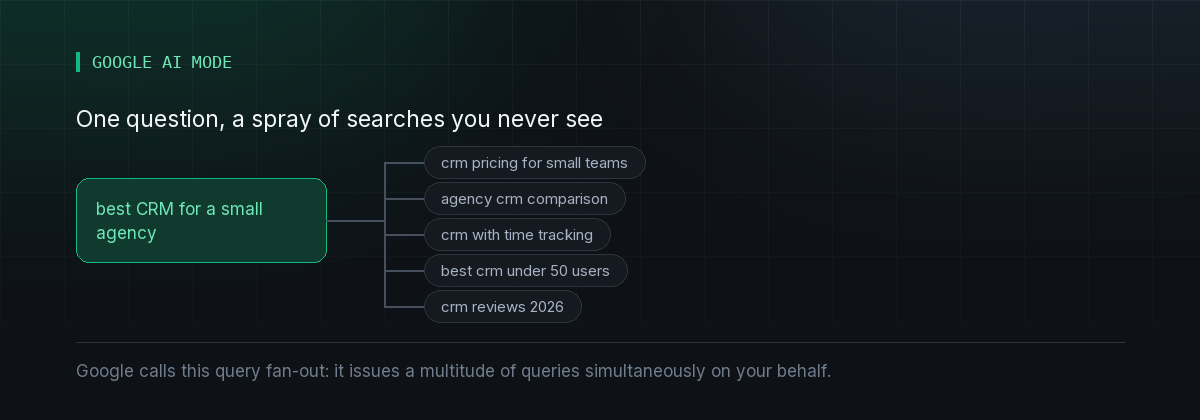
AI Mode doesn’t run your question as one search. Google describes the technique on its product blog as breaking a question into sub-topics and “issuing a multitude of queries simultaneously on your behalf,” across the web, the Knowledge Graph and the Shopping Graph.
Robby Stein, Google’s VP of Product for Search, put it more plainly in April 2025.
For any question, it makes a plan, breaks it down into related subtopics, and runs multiple Google searches to find the most helpful and reliable info.
Robby Stein, VP of Product, Google Search, 16 April 2025
The Gemini API documents the same behaviour for developers: the model decides whether a search helps, then “automatically generates one or multiple search queries and executes them.” Google bills each of those as a separate grounded use, which is a useful confirmation that the fan-out is real rather than a metaphor.
This is the single most important mechanical difference from classic search. You aren’t competing for one query any more. You’re competing across a spray of sub-queries you never see, which is why pages ranking for adjacent long-tail terms get pulled into answers about something broader.
What Google tells site owners to do
Google’s guidance page on AI features is unusually direct, and it closes off three of the things being sold as GEO.
There are no additional requirements to appear in AI Overviews or AI Mode. You don’t need to create new machine readable files, AI text files, or markup to appear in these features. There’s also no special schema.org structured data that you need to add.
Google Search Central, AI features and your website, updated 10 December 2025
The controls it does offer are the ones you already have: nosnippet, data-nosnippet, max-snippet and noindex, the same directives that governed classic snippets.
Danny Sullivan, Google’s Search Liaison, made the same point on the Search Off the Record podcast in December 2025, saying structured data “still matters” while adding that “it’s not structured data and you win AI.” John Mueller, asked on Reddit whether extensive schema helps language models, answered “the short answer is yes, no, and it depends,” and flagged it as his personal view rather than official guidance.
The controlled evidence agrees with the documentation. Ahrefs tested 1,885 pages that added JSON-LD against roughly 4,000 matched controls and found AI Mode citations moved 2.4%, indistinguishable from zero, while AI Overview citations fell 4.6%.

Not sure which of this matters for your site?
I am Eric. Give me 30 minutes and I will look at your site and tell you which of these things would move anything for you, and which you can skip.
Book a free call →How much AI citation tracks organic ranking
Every large study finds a real relationship and none of them agree on its size. That disagreement is the most useful thing in this section, because it tells you how much confidence any single number deserves.
| Study | Sample | Cited pages also ranking organically |
|---|---|---|
| Ahrefs, July 2025 | ~1.9m AI Overview citations | 76% in the top 10 |
| seoClarity, October 2025 | 362,000 queries | ~56% in the top 20 |
| BrightEdge, September 2025 | 9 industries, 16 months | 54.5% in the top 10 |
| Ahrefs, March 2026 | 863,000 keywords, ~4m URLs | 38% in the top 10 |
Ahrefs’ own figure halved in eight months on the same style of measurement, and nobody has explained why. In its March 2026 data the citations that weren’t in the top 10 split almost evenly between positions 11 to 100 and pages ranking beyond 100.
Two conclusions survive the spread. Ranking well makes citation substantially more likely, and it guarantees nothing, because a page nobody can find in the SERP can still be pulled into an answer.
The claim that SEO is dying
Per-query, AI Overviews suppress clicks. Pew Research tracked 68,879 real Google searches from 900 US adults in March 2025 and found users clicked a traditional result on 8% of visits where an AI summary appeared, against 15% where it didn’t. They clicked a link inside the summary on 1% of visits, and ended the session entirely 26% of the time versus 16%.
In aggregate, the picture is much calmer. Graphite analysed Similarweb data across the top 40,000 US websites and found organic search traffic down 2.5% year over year, with the largest sites up about 1.6%. Google stated in August 2025 that total organic click volume from Search was relatively stable year over year.
Both are true at once. AI Overviews appear on a minority of queries, weighted toward informational ones, so a real per-query click collapse coexists with roughly flat totals for large sites, and the pain lands on mid-sized publishers.
Meanwhile AI Mode itself is still tiny. SparkToro’s analysis of Similarweb panel data for January to April 2026 found 0.34% of Google searches moved into AI Mode. Organic search remains the channel most websites live on, and treating it as finished is a good way to lose the traffic you still have.
Google-Extended and what it doesn’t do
Google-Extended is a robots.txt token rather than a crawler. Google’s crawler documentation states it “doesn’t have a separate HTTP request user agent string” and that “crawling is done with existing Google user agent strings,” so it’s a permission flag on content Google already fetched.
What it controls is narrow: whether your content “may be used for training future generations of Gemini models.” Google is explicit about the rest.
Google-Extended does not impact a site’s inclusion in Google Search nor is it used as a ranking signal in Google Search.
Google Search Central, Google crawlers documentation
Agencies conflate those two things constantly, usually while quoting a fear about disappearing from Google. Disallowing Google-Extended is a decision about training data, and the related split across the other crawlers is worked through on the Common Crawl bot page.
What to do about it
Build for the fan-out. Cover the sub-questions around your main topic properly, on pages that can each answer one thing completely, because the fan-out is what surfaces them.
Rank. Every study above says organic position raises citation odds, so the ordinary work of content quality & earned links is the work. Then get mentioned on the third-party pages that already rank for your category, since the fan-out reaches those too.
Leave the schema rebuild and the llms.txt file alone until someone shows you a controlled test. Google has now told you twice, in its documentation and through its Search Liaison, that neither is required. The other engines differ in the details, covered on the ChatGPT GEO, Perplexity GEO and Claude GEO pages.
Sources
- Google, expanding AI Overviews and introducing AI Mode, query fan-out
- Google, Grounding with Google Search, Gemini API documentation
- Google Search Central, AI features and your website
- Google Search Central, Google-Extended and common crawlers
- Ahrefs, AI Overview citations and the organic top 10, March 2026
- seoClarity, AI Overview and ranking overlap, 362,000 queries
- BrightEdge, rank overlap after 16 months of AI Overviews
- Ahrefs, schema markup and AI citations, controlled study
- Pew Research Center, clicks when an AI summary appears
- Graphite and Similarweb, organic traffic across the top 40,000 US sites
- SparkToro, zero-click searches and AI Mode share, 2026
- Danny Sullivan on SEO for AI, December 2025
- John Mueller on schema and language models, January 2026
Eric Wilkinson
I run WilkiLeads, a one-person SEO and web consultancy. I work on search visibility, site rebuilds & the technical side of getting pages indexed, cited and found.
Book a free 30 minute call →Find out what’s holding your site back.
I review your website personally and write a prioritised action plan for your exact site: what to fix first, what to ignore, and what will move rankings.
Keep reading
ChatGPT GEO
What ChatGPT reads before it answers, what the citation studies show, and which GEO tactics have evidence behind them.
29 Aug 2026 · 6 min read
Perplexity GEO
The engine whose citations track Google rankings most closely, and the one with the most contested crawling record.
29 Aug 2026 · 4 min read
Claude GEO
The thinnest evidence base of the four engines. What Anthropic documents, what researchers established, and where nobody knows.
29 Aug 2026 · 4 min read