Common Crawl Index
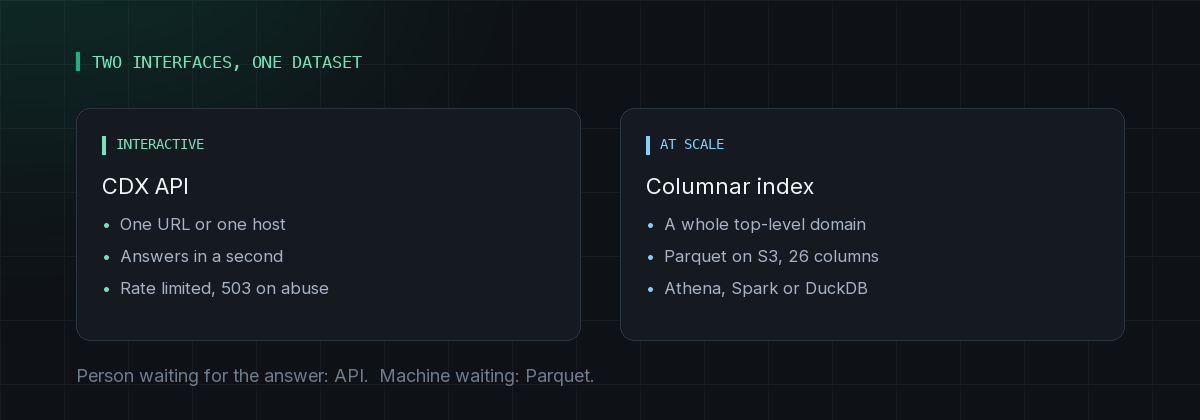
Two indexes cover the same crawls. One answers single lookups, the other scales to whole top-level domains.
The Common Crawl index maps a URL to the exact file, byte offset and length where its archived copy sits. Without it, finding one domain inside the 84.69 TiB of WARC data in a single crawl would mean reading all of it.
Two indexes exist over the same data, and they suit opposite jobs.
The CDX API
The URL index server runs pywb at index.commoncrawl.org and answers queries over HTTPS. Each crawl has its own endpoint named after the crawl id, and the full list of collections is published as machine-readable JSON at /collinfo.json.
curl -s "https://index.commoncrawl.org/CC-MAIN-2026-30-index?url=example.com/*&output=json"Each result line carries the URL, the fetch timestamp, the HTTP status, the MIME type, a content digest, and the three fields that matter for retrieval: filename, offset and length. Those three let you pull one page out of a multi-gigabyte archive with a ranged HTTP request against https://data.commoncrawl.org/.
The server is heavily rate limited, and going too fast returns 503 and can block your IP for a day. That’s covered on the Common Crawl rate limit page.
The columnar index
The columnar index holds the same records in Apache Parquet at s3://commoncrawl/cc-index/table/cc-main/warc/, partitioned by crawl and subset. It carries 26 columns covering URL components, host and registered domain, TLD, MIME type, detected languages, content digest, fetch status & the WARC filename with record offset and length.
Columnar storage is what makes it fast. A query touching three columns reads only those three, so a per-domain count over a whole crawl can scan a few megabytes rather than terabytes. Common Crawl’s own worked example on Athena scanned 2.12 MB and cost under a cent.
SELECT url, fetch_status, warc_filename
FROM ccindex
WHERE crawl = 'CC-MAIN-2026-30'
  AND subset = 'warc'
  AND url_host_registered_domain = 'example.com'
Athena, Apache Spark and DuckDB all read it in place. The data sits in the public commoncrawl bucket in us-east-1 and needs no AWS credentials, so --no-sign-request is enough for the S3 CLI.
Which one to use
| Job | Index |
|---|---|
| Check whether one page was crawled | CDX API |
| List a single domain’s crawled URLs | CDX API |
| Every URL on a TLD | Columnar |
| Counts, joins or aggregation | Columnar |
| Anything scripted across thousands of hosts | Columnar |
| Anything you will rerun | Columnar |
The dividing line is simple enough to apply without thinking about it. If a person is waiting for the answer, query the API. If a machine is, query Parquet.
For what the index points at, and how a crawl is packaged into WARC, WAT and WET files, see Common Crawl.

Eric Wilkinson
I run WilkiLeads, a one-person SEO and web consultancy. I work on search visibility, site rebuilds & the technical side of getting pages indexed, cited and found.
Book a free 30 minute call →Find out what’s holding your site back.
I review your website personally and write a prioritised action plan for your exact site: what to fix first, what to ignore, and what will move rankings.
Keep reading
Common Crawl Rate Limit
The CDX index server is heavily rate limited. What triggers a block, how long it lasts, and the interface that has no limit.
29 Aug 2026 · 2 min read
What Is Common Crawl
A free archive of the public web, published monthly since 2008. What a crawl contains and what it means for your site.
29 Aug 2026 · 8 min read
Common Crawl Bot
CCBot reads robots.txt, publishes its IP ranges, and can be blocked in two lines. What that block does and does not reach.
29 Aug 2026 · 2 min read