Common Crawl Alternatives
No public archive replaces it outright. Four routes that cover most of what people use it for.
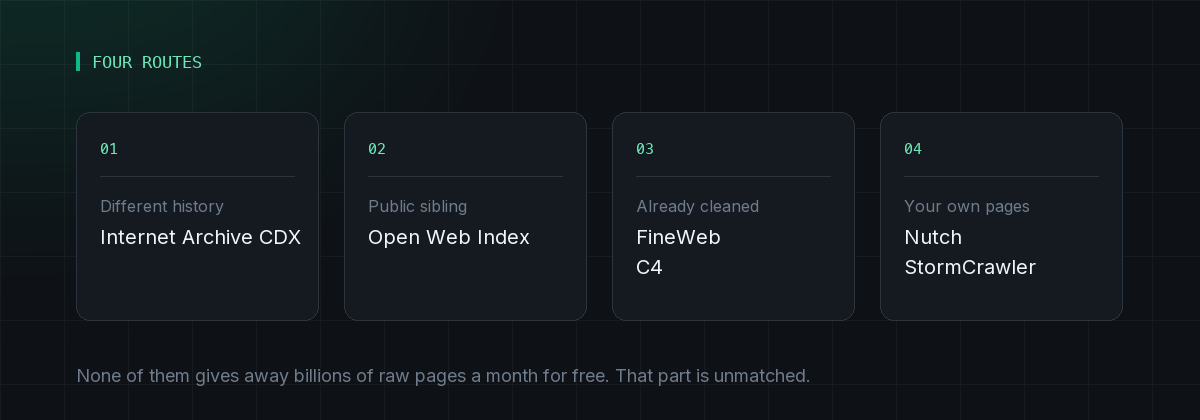
Nothing replaces Common Crawl on its own terms. No other public archive gives away billions of raw pages a month with no account, no contract and no charge beyond bandwidth. The useful question is which substitute fits the job you were using it for.
Four routes cover almost every case.
Archives with a different history
The Internet Archive holds far deeper history than Common Crawl and exposes it through its own CDX API at web.archive.org/cdx/search/cdx, with the same URL, timestamp, status and digest fields. It’s the right source for tracking how one page changed over years. Bulk access is a conversation with the organisation rather than an open bucket.
The Open Web Index is the closest thing to a public sibling. Built by OpenWebSearch.eu, a Horizon Europe project that started in September 2022 with 14 European research institutions including CERN, it released a federated pan-European index for research and development use in August 2026 after the 42 month programme ended.
Pre-cleaned corpora built from the same crawls
Most people reaching for Common Crawl want text for a model, and the filtering is the expensive part. FineWeb, released by Hugging Face in May 2024, is around 15 trillion tokens processed from 96 Common Crawl snapshots between summer 2013 and April 2024, with a 1.3 trillion token educational subset called FineWeb-Edu. Google’s C4 came out of a single 2019 snapshot for training T5.
These aren’t independent sources. They’re Common Crawl with the cleaning already done, so they inherit its coverage gaps along with its convenience.
Running your own crawler
Crawling yourself is the only option that gives you exactly the pages you want, at the freshness you want, under your own robots.txt compliance. It’s also the one with real running costs.
Apache Nutch is the crawler Common Crawl’s main crawl is built on. StormCrawler, which runs on Apache Storm, is what the foundation uses for its daily CC-NEWS crawl. Scrapy suits smaller, targeted jobs. Budget for storage, politeness delays, IP reputation and the ongoing maintenance of a system that breaks quietly.
Commercial indexes and datasets
Ahrefs, Majestic and DataForSEO run their own crawlers & sell API access to link graphs and page data. Coverage is narrower than Common Crawl in raw page count, and considerably better on the freshness of links to a given domain. Vendors such as Bright Data and Zyte sell managed collection instead of an archive.
| If you need | Use |
|---|---|
| Historical versions of specific pages | Internet Archive CDX |
| An EU-governed open index | Open Web Index |
| Cleaned pretraining text | FineWeb or FineWeb-Edu |
| Exact pages, current, on your terms | Nutch, StormCrawler or Scrapy |
| Fresh link data for SEO | Ahrefs, Majestic or DataForSEO |
| Managed collection with support | Bright Data or Zyte |
Before switching, confirm the original constraint. A lot of teams look for an alternative because the CDX API keeps returning 503, which the Common Crawl rate limit page solves without leaving the project, usually by moving the same query to the columnar index described on the Common Crawl index page.
For what the archive holds and how it’s licensed, see Common Crawl.

Eric Wilkinson
I run WilkiLeads, a one-person SEO and web consultancy. I work on search visibility, site rebuilds & the technical side of getting pages indexed, cited and found.
Book a free 30 minute call →Find out what’s holding your site back.
I review your website personally and write a prioritised action plan for your exact site: what to fix first, what to ignore, and what will move rankings.
Keep reading
What Is Common Crawl
A free archive of the public web, published monthly since 2008. What a crawl contains and what it means for your site.
29 Aug 2026 · 8 min read
Common Crawl Index
Two indexes cover the same crawls. One answers single lookups, the other scales to whole top-level domains.
29 Aug 2026 · 2 min read
Common Crawl Rate Limit
The CDX index server is heavily rate limited. What triggers a block, how long it lasts, and the interface that has no limit.
29 Aug 2026 · 2 min read